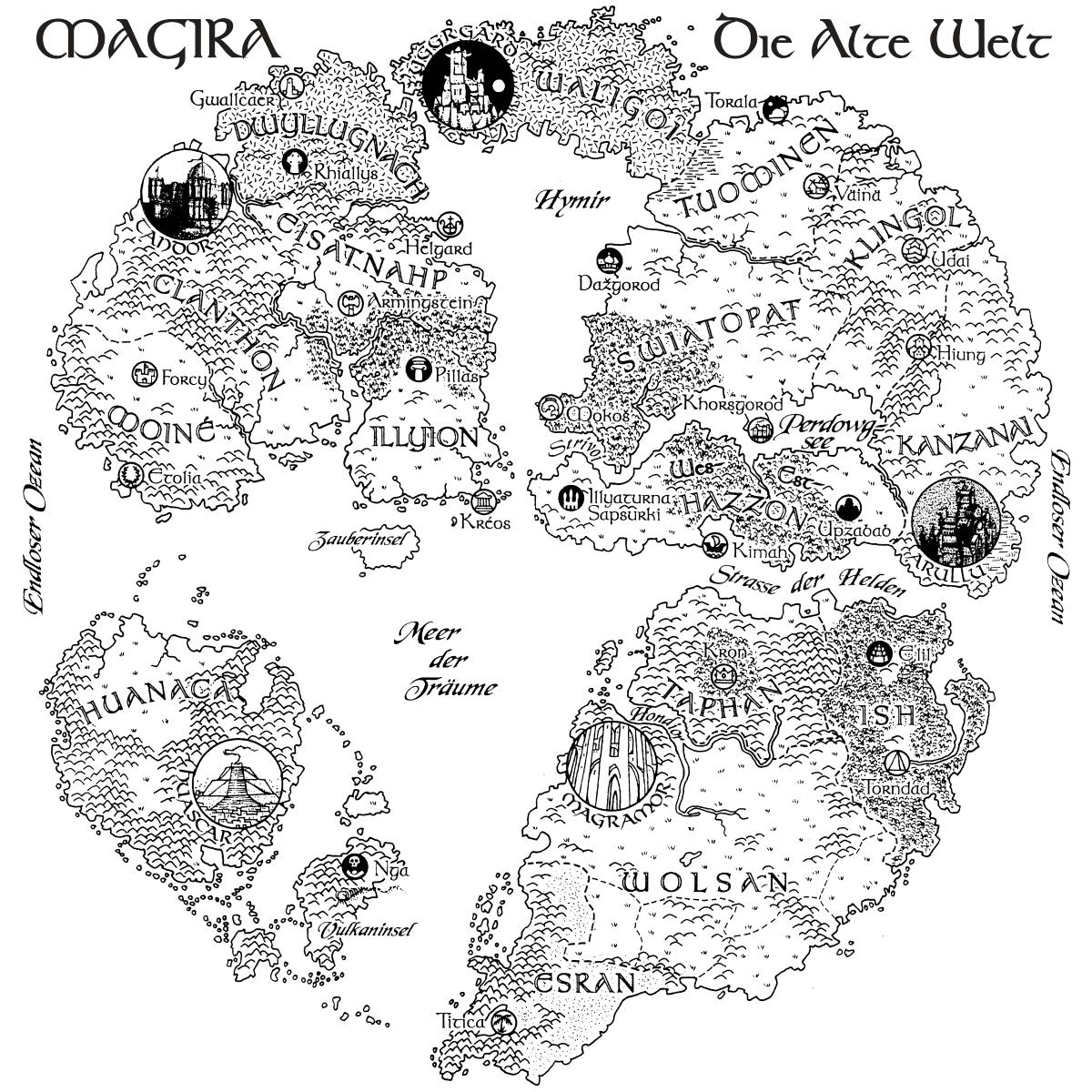
A major theme that has developed on this blog is that of the beauty--and yes, fun--of a shared world-building experience. Invariably when talking about Tekumel or Glorantha is the comparison of those world's broad, expansive visions to that of Tolkien.
But what those observers often don't get, or at least state, is that the nature of gaming in a world, even ones that have fine level of detail courtesy courtesy of a single creator and final authority, invariably makes that world a collective experience. Hundreds of Tekumels and Gloranthas have existed in varying degrees of canonical imitation.

What I find most interesting about our recent exploration of the German-Austrian worldgame Magira is that since 1966 this world has allowed thousands of participants a chance to build a corner of that world—and as you will see in this following (pun somewhat intended) interview a chance to fight for your collectively-shared nation in that open world.
Thanks to the recent articles here on Magira I received some great and helpful responses from German readers. One of them was from a long-time participant in the fantasy society that founded Magira, the Fellowship of the Lords of the Lands of Wonder (FOLLOW). His “character name” in Magira is Dhokaj.
Hill Cantons: Can you tell me about the history of FOLLOW? How did it start? What were the society's goals?
Dhokaj: FOLLOW was founded in 1966 by Hubert Strassl (aka Hugh Walker), Eduard Lukschandl, and Axel Melhard. They wanted to create a club about fantasy literature (which was practically non-existent in Germany at that time).
Dhokaj: FOLLOW was founded in 1966 by Hubert Strassl (aka Hugh Walker), Eduard Lukschandl, and Axel Melhard. They wanted to create a club about fantasy literature (which was practically non-existent in Germany at that time).
They also had the idea of a structure that resembled medieval European society with its nobles and knights. They wanted to have a hierarchy in which you could rise by being active (writing stories, etc.)
Therefore they founded “Clans” that represented realms, nations or civilizations. Each Clan had a “Lord” or a “Lady” who was the leader of the clan (the top of the hierarchy) and a crest, normally with an animal as a symbol.
Therefore they founded “Clans” that represented realms, nations or civilizations. Each Clan had a “Lord” or a “Lady” who was the leader of the clan (the top of the hierarchy) and a crest, normally with an animal as a symbol.
HC: How did Magira start? When and how did Armageddon and other games begin?

D: The first Armageddon boardgame took place in 1968. This marks the beginning of the world Magira and of the Ewiges Spiel, the “Eternal Game”, that is still being played today. They needed a game plan and created the Old World of Magira (the one you posted in your blog) as a hex map for that purpose.
So Magira is a fantasy world that contains the civilizations that are represented by the Clans. Each Clan has the right to take part in the Eternal Game to defend its territory or to wage war on others.
Each member of a clan represents a personality of the people that is simulated by their clan. But this is not a role playing approach in the form of rules. It is more a literary approach, so the personalities could be a slave on a galley, a mighty demon or a skilled bard–this depends on the clan you're in.
Each member of a clan represents a personality of the people that is simulated by their clan. But this is not a role playing approach in the form of rules. It is more a literary approach, so the personalities could be a slave on a galley, a mighty demon or a skilled bard–this depends on the clan you're in.
 |
| An assault on the Citadel of the Gods in Armageddon |
HC: Who is involved with FOLLOW and Magira in current years? What kinds of activities do you do?
D: At the moment Follow is made up of 78 clans but not all of them are active and not all of them are taking part in the eternal game. But the Eternal Game is still being played once a year for three days and what is played is the basis for the political structure and the historical development of the world Magira.
There are roughly 400 to 500 fellows (members of FOLLOW) and the clans range from 1 to 40 members.
The activities cover a very wide range from playing Armageddon to creating costumes, writing stories, composing and performing music, role playing and so on.