Monday, January 10, 2011

Peeking Under the Hood of the Domain Game Experiment

[Editor's Note: I inadvertently failed to cut and paste the fourth layer in my original post. Corrected in the text below.]

I continue to be amazed by the creative dimensions of the Domain Game experiment so far. The cultural background and detailed (and quirky) action write-ups are simply blowing me away, the 80-plus pages (!) of material produced by players is richly imaginative and providing a great launch for this project.

As I noted before I will be leaking from time to time more sneak peeks into how the game is evolving. 

Today's reveal is of two things of possible interest to readers. The first is the working guidelines and outline that I am using to help shape the play test game. As it gets updated--and some serious flesh to the skeleton will be coming later this week as the list at the end gets completed--readers will be able to get some glimpses into the trajectory of the project. Read them here if you are interested .

The second you will find below and pertains more to the overall goals of the experiment—and the game aid supplement that will hopefully follow in its wake.

The Four Layers of the Domain Game
The supplement will be divided into four layers. Instead of lumping this kind of play into one uniform mechanic it will try and dig into how this area of the game can be played in very different ways according to the power scale and technological/political/cultural context of each campaign. Each layer will basically be posing different sets of questions and have suggestions for the kinds of mechanics and play that may help answer each.

Again the overall goal is to provide elements to spur and expand open-ended play as it “feels right”. Each layer of the supplement will also have two tracks GMs decide on how and what to adopt/change/modify for the particular conditions of their campaign: 1. a “rigorous” path with detailed sub-systems; and 2. a “lazy” path that provide suggestions on how to introduce play in a domain game as more of a back drop (suggestions to include how and what works best to hand wave).

The layers can be either custom-fitted to fill out one area in a campaign using one or more layers or if desired more in a linear fashion with characters moving up the layers and ranks as they gain power.

Layer One: Non-Ruler Domain Play
This layer is aimed at low-to-mid level characters. The given assumption for this layer is that players will not be rulers, but playing roles inside institutions that introduce them to this type of play. Here will go suggestions for exhaustive lists of hierarchies of various fantasy institutions and guidelines for how players can advance in them as part of the campaign.

Mechanically, emphasis will be on subsystems and mini-games that happen when primary domain decision making is “off stage”. En Garde and Heroes are inspirational sources here.

Layer Two: Entry-Level Domain Play
This layer will allow mid-to-name level characters a chance to be low-level decision makers or rulers. Emphasis here will be on large-scale exploration, wilderness clearing (or adaption), and laying the foundation for a new domain. (Our current play test is laser-beam focused on exploring the dimensions of this layer.)

Here we have an emphasis on a highly granular, direct (or command) decision making. Depending on which elements from this layer the GM and players feel comfortable with they will have hands-on decisions to make as they face the harsh conditions of founding an outpost.

Layer Three: Domain Play
This level focuses on play for small to mid-sized settled states typically for name-level players. If evolving out of the previous layer it's a wilderland becoming a borderlands area.

The micro-focus of the previous layer is shifted to new guidelines. Direct decision making questions like how to get your followers fed/clothed/housed or shifted to more indirect considerations where the domain residents are acting more as autonomous economic actors. Players will be less micro-managing their followers activity and more thinking of ways to tax, govern, and harness their productivity.

Similarly combat is becoming more large-scale with emphasis on mass battle rules over skirmish ones. Diplomacy, espionage, macro-trade and other considerations become more central arenas.

Layer Four: Worldgame Play
Here we get to the ruling of large-scale countries, planets, or planes of existences even. Domain management will become increasingly abstract and far-reaching as play extends out to this layer.  

Saturday, January 8, 2011

Growing the Domain Game From the Bottom Up

Turn one of the domain game is now underway. Fifteen crazy-quilt expeditions are now moving nomad bands, erecting cabins/long houses, chasing game, exploring ominous ruins, and generally scouting new vistas throughout the new world of Nowhere as I type.

We are less than a week in and I am already feeling at a gut level the both the sheer joy and the sheer amount of busy work that Tony Bath gushes about throughout his writings on the Hyborian campaign. Anyone putting up there hand to play Assistant Deity out there haha?

From a game design perspective I am pleased as punch on how this is shaping up. The bottom-up, build-as-you-go approach which aims at answering the rigorous questions flying around so far is tough, labor-intensive work, but satisfying. I have been deeply impressed by the creative drive and hard work players have already put into creating their bands—and for pushing me to keep expanding the bounds of this project. Pat yourself on the back readers.

(BTW those interested in following the game as a spectator can find a sample of the first turn sit-rep and turn sheet here. For time-to-time I will be posting non-spoiler observations on what's going on in the strange new world. )

Tomorrow I will post about the four major play areas that this whole domain game experiment is exploring. 

Thursday, January 6, 2011

Experience with Domain-Level RPG Play?

The correspondence has been flying fast and furious in the last two days between the 14 current players of the domain game experiment and yours truly.

One interesting, tangential observation I have drawn from it is the number of players who have said—and many of these are long-time players and refs mind you—that their actual playing experience with this kind of play at the tabletop is minimal to non-existent. Much more of it seems to have been with computer games if anything.

Which makes me curious about the why. How many readers out there have had experiences with this level of play in a tabletop rpg? What was it like? What worked for you? What didn't?

And if you haven't, what was holding you back? 

Wednesday, January 5, 2011

The Worldgame is Afoot

I suppose I should have expected it--one should never underestimate my capacity for underestimation—but I am blown over by the number of eager participants who have ponied up for the domain-level experiment I threw out there yesterday.

Despite a little scrambling to accommodate the wave, I have been adopting a more the merrier outlook--perhaps something I will have to modify if the pace of volunteers continues. To date we have 15 players, with seven of them already laying out the realms they represent.

And what a bunch!

To preserve the mystery until the plot thickens through play in the coming two months I will keep mum, but man is it tough. Suffice it to say what a crazy imaginative crew has assembled to tame this brave new world. I think all will be surprised by what they will find around the corner.

More details of the worldgame for players and ring-side readers follow below.

Starting Equipment and Followers
Each player in the play-test game will start with 2,000-5,000 gold pieces worth of starting resources. Hiring of all followers is made for one month's salary in the Hiring Specialists and Mercenaries section of the LL book (p. 47-48). Equipment is purchased from the LL standard equipment list (p.15-16)

(Alternately you can let the GM make purchases for you.)

Odd rules to keep in mind:
  1. Hiring of henchpeople (followers with class levels) costs 200 gp/level one-time purchase. They will appear with mundane gear appropriate to their station. Followers must be at least one level lower than the PC.
  2. Soldiers will come with the arms and armor stated in the book. Additional gear must be purchased as above.
  3. Portage of items from the motherland through wilderness and an extra-dimensional gate about a small wagon sized in width should be considered. (No large ships for instance.)
  4. Laboring families (one potential club-armed combatant, four non-combatants) can be hired/indentured at the price of 4 gp/month.
  5. Preserved foodstuffs can be bought in four-week batches at a cost of 10 gp per individual (100 for 10, 1,000 for 100).
  6. Any item not appearing on either list desired should be checked with the GM who will be happy to pull a price out of his improvising rear.
Starting Position
Each player's band will pop through a gate bordered by a mysterious monolithic basalt obelisk into a narrow stretch of land explored by the advance party. Each player will thus be given a map marked off with five-mile hexes as pictured below.


Expanding that map (and the knowledge of what lies off the horizon) is up to the player...

Tuesday, January 4, 2011

Who Wants to Play a Worldgame?

The holidays may have been a wash for the blog, but they weren't for my game tinkering. I managed to write a rough outline for the domain-level classic D&D guideline supplement I was yakking about last month.

Thinking over the initial outline—and many of your comments—I was struck (especially again by Rob Kuntz's perceptive ones) by the notion that you shouldn't try to build these kinds of things in a vacuum. Why start with an abstract rules framework and try to shoe-horn play to fit? Why not start playing and see where that goes and what comes out of it?

Skipping to the chase, I would just like to jump right in and open up a play-by-email-game to grow this bad boy organically.

Here's the set-up:

You are a lesser noble or official of a fantasy realm with a technology and culture spanning from antiquity to late middle ages. Footless roguish adventuring types have found extra-dimensional gates/portals/nexus points leading to a strange land seemingly unoccupied by sentient beings.

The ruling body of your land has tasked you with leading a colonizing/exploratory mission into this land to carve out a realm in this brave new world. With a small group of henchpeople, soldiers, and civilian colonists in tow you have passed through the gates and scouted out a place to plant your flag.

Are you up for the challenge?

How it will work:
  1. Each fortnight I will email you a situation report. You will then write up your actions for the coming two weeks.

  2. Play will be wide open and free form option-wise.

  3. Basic mechanics for individual situations will be provided by the B/X D&D or Labyrinth Lord rules (free download here).

  4. Rules for prices and other domain-level mechanics will be revealed as your actions or questions to me as game master come up.

  5. Players can cooperate or compete with other players to their heart's desires as they come into contact with other domains.
Requirements to play:
  1. Strong commitment to promptly writing your action report for each turn on a fortnightly basis. Minimum commitment to the two-month play testing period starting this week (we'll extend it indefinitely if it has momentum and critical mass enough to sustain). Thus you are on the hook for about four turns. 

  2. A write-up of the imagi-nation that your character represents (name of the nation, government type, cultural details, religion, etc). Detail here will make it more fun and more of a world co-creation, but if you want to start with scant detail and build it up as you play that's more than fine too. If you have a buddy that wants to play you can start as part of the same “team” (this will give you a small advantage in fact).

  3. Roll up a character using the B/X D&D or Labyrinth Lord rules. Roll 4d6 (drop the lowest) in order for attributes—except for Charisma for which you roll 2d6+6 (hey, you are an important dude). You will start at 10,001 exp and maximum hit points. Assume that you have all the mundane equipment list.

  4. Provide me feedback on how the game is working (or not) in the play-test period.

  5. Email me at kutalik at gmail dot com with your character and write-ups.   

Monday, January 3, 2011

Random-Ass Monday: Space Opera Tékumel and the Paladin à la Holmes

As a general rule I hate secondary commentary as it's an awfully cheap and lazy way to run a blog, but I promise to be posting something else of more-or-less substance later today or tomorrow as I coast out of the Holidaze. Hey, at least I'm not tormenting you with an eye-glazing rundown of 2011 resolutions. Yet.

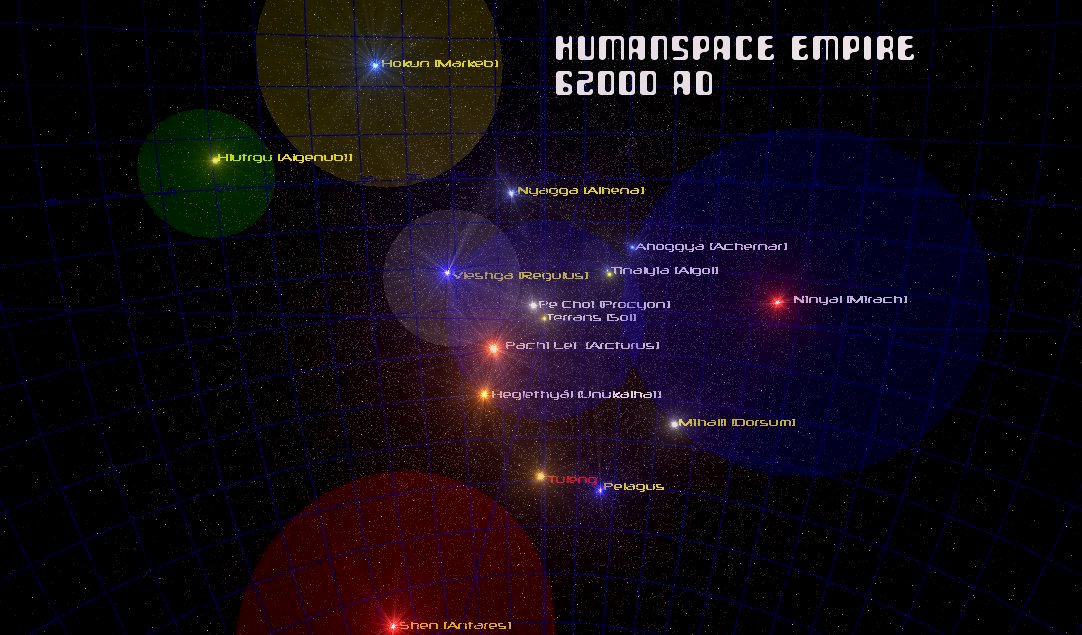
First up of special note is The Drune's two-post musings on the potential of pre-pocket universe Tékumel as a space opera setting (thanks to HC player Desert Scribe for flagging this for me over at Super Galactic Dreadnaught). He does a bang up job of putting together M.A.R. Barker's writings hinting at the sci-fi pre-history of the planet, including a very nice star map approximating the positions of the human empire and the stellar locations of Man's allies (pictured below). 

Tékumel lore is replete (perhaps Jeff Berry could help us out here) with tantalizing details about the space-faring technologies of Humanspace. I remember positively salivating on reading yahoo group posts by such old hands like Victor Raymond throwing out lists of campaign finds of such wonders as weather control machines; gravity engines at the core of the planet; Ahoggya-built starships (that can only be piloted by four people due to their eight arms); planetary defense batteries on one of the moons, etc.. Throw in some other details about starcraft and other oddities at the end of Barker's Lords of Tsamra and other tidbits from the good Professor and you start to get the foundation for a really interesting space opera setting.

So here's to The Drune coming through with his plans to publish a free gaming supplement putting this all together in the months ahead. I would expect nothing less from a first-place loser.

Turning to something closer to medieval fantasy, I thought Jeff Rients' recent spin on the Paladin for his Surfeit of Lampreys campaign to also be an incredibly nice way to start off the new year given my own pipe dream fantasy about wanting a “Holmesian” expansion. Suitably Jeff goes beyond just re-bolting some OD&D bits back onto a Blue Book chassis and making a proper variant class with all the simplicity and oddness (as compared to the other strains of D&D that is) of the original.

I half-seriously commented at the time of my Holmes Expert thought experiment that Jeff would be the perfect draftee for the project, I would now like to go full serious with that one. As to my own plans around this, at the least I may try a hand at some Holmes-like variant classes such as the Witch or such like.

But that gets us back to resolutions...