Showing posts with label Holmes. Show all posts

Monday, January 13, 2014

Holmes Homecoming

Saturday was so amazingly nice that I had to gut check my Slavic patrimony (nope, optimists are still those who think things can't get worse). It was a brilliant, mellow wintry sunny morning, my week of solid sleep deprivation had been whipped and best of all thanks to Mack of Super Galactic Dreadnought infamy I had a chance after 33 years to play Holmes Basic again.

I have not done nostalgia well in the last two years.

Way back in the hoary, time-misted year of 2008, when giants walked the earth and playing old school D&D was still a bit of an insurgency (or reaction)--you know when things were cool and you weren't there--I will freely admit to the sweet, sharp pain of nostalgia being a major draw back to reentering the hobby.

Six years later, though still playing more or less the same system, the campaign has grown out way more complicated than that simple back-to-basics pull. And I have seemed to break--with relish even--just about every rule I set out in the beginning not to do (have I told you about my 60-plus page Hill Cantons setting book recently?).

But sentimentality has a way of sneaking up on you. Over the holiday break I had a chance to make up to my mom's aging ranch-style house outside Fort Worth. To my more than I care to admit excitement she had a single box of my old roleplaying collection that she salvaged from the clutter demons of the garage. And in that box, coverless and heavily marked with urgent penciled in notes, was the Holmes rulebook that started all this at the ass end of 1979.

Long wind up here, Mack running his game (apparently his first DM role since the 1980s which you would never guess by the smoothness of the session) hit exactly at the right time. It was refreshingly..umm...“basic”.

It was the old 3d6 in a row. I promptly, and not-so imaginatively picked the same race and mandated class I always did back then, and never have since, an elf fighter/magic user. Even named him the same as my perennial character back then, Evaro IV. (Evaro I and II died quick unmemorable deaths in the Caves of Chaos, Evaro III graduated to AD&D and had a long, full life on the Wild Coast).

It was also all about the dungeon, a “wizard did it” affair and nameless “town.” For four hours the six of us fought, bullshited, retreated, skulked, and explored a surprisingly-large number of rooms (I guess I have become too used to the slower pace of online games). There were skeletons with mysterious keys on tethers, a witch-polymorphed “frog”, a gnome-whipped gnoll, a terrifying harpy and innumerable fights and near-calls.

It felt like coming “home”--and it was hella fun.

Monday, January 3, 2011

Random-Ass Monday: Space Opera Tékumel and the Paladin à la Holmes

As a general rule I hate secondary commentary as it's an awfully cheap and lazy way to run a blog, but I promise to be posting something else of more-or-less substance later today or tomorrow as I coast out of the Holidaze. Hey, at least I'm not tormenting you with an eye-glazing rundown of 2011 resolutions. Yet.

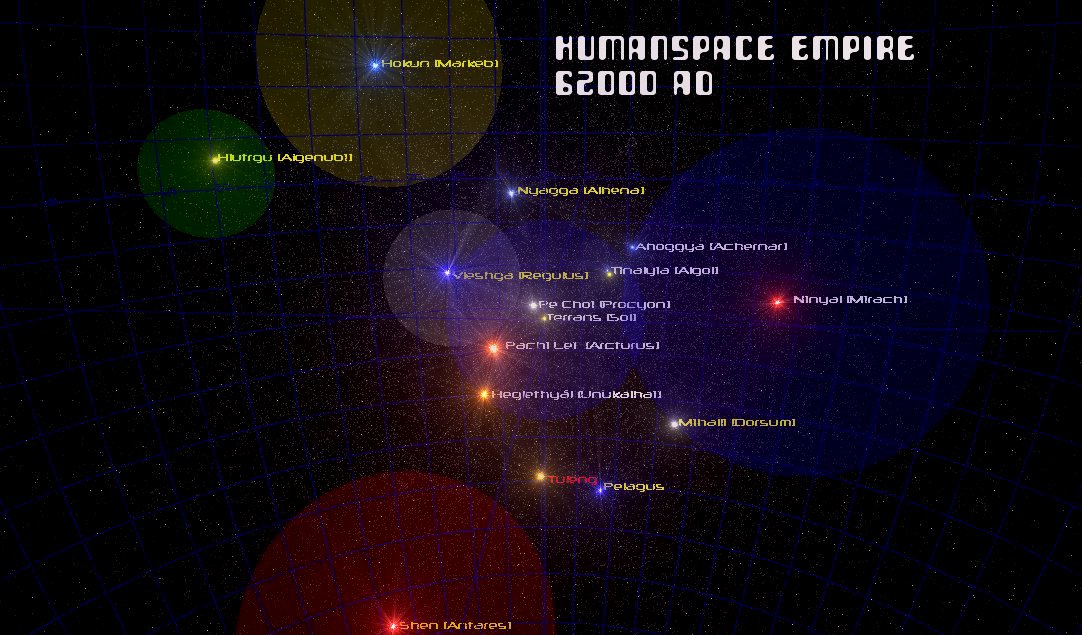
First up of special note is The Drune's two-post musings on the potential of pre-pocket universe Tékumel as a space opera setting (thanks to HC player Desert Scribe for flagging this for me over at Super Galactic Dreadnaught). He does a bang up job of putting together M.A.R. Barker's writings hinting at the sci-fi pre-history of the planet, including a very nice star map approximating the positions of the human empire and the stellar locations of Man's allies (pictured below). 

Tékumel lore is replete (perhaps Jeff Berry could help us out here) with tantalizing details about the space-faring technologies of Humanspace. I remember positively salivating on reading yahoo group posts by such old hands like Victor Raymond throwing out lists of campaign finds of such wonders as weather control machines; gravity engines at the core of the planet; Ahoggya-built starships (that can only be piloted by four people due to their eight arms); planetary defense batteries on one of the moons, etc.. Throw in some other details about starcraft and other oddities at the end of Barker's Lords of Tsamra and other tidbits from the good Professor and you start to get the foundation for a really interesting space opera setting.

So here's to The Drune coming through with his plans to publish a free gaming supplement putting this all together in the months ahead. I would expect nothing less from a first-place loser.

Turning to something closer to medieval fantasy, I thought Jeff Rients' recent spin on the Paladin for his Surfeit of Lampreys campaign to also be an incredibly nice way to start off the new year given my own pipe dream fantasy about wanting a “Holmesian” expansion. Suitably Jeff goes beyond just re-bolting some OD&D bits back onto a Blue Book chassis and making a proper variant class with all the simplicity and oddness (as compared to the other strains of D&D that is) of the original.

I half-seriously commented at the time of my Holmes Expert thought experiment that Jeff would be the perfect draftee for the project, I would now like to go full serious with that one. As to my own plans around this, at the least I may try a hand at some Holmes-like variant classes such as the Witch or such like.

But that gets us back to resolutions...

Thursday, November 11, 2010

Split Classes and Holmes Expert

Jim (aka the Wampus) asked yesterday what I meant by saying that split classes were a likely design choice for our hypothetical Holmes Expert set. My line of reasoning flows back to 1984 when Frank Mentzer's third boxed set for D&D, the Companion set, reared its head.

In that edition, a number of new classes were introduced, not as stand-alone classes in which a player starts at first level and works as usual up the ranks, but as a career choice for certain qualifying characters of the basic classes as they reached name level. (BTW Grognardia had a recent interesting discussion on this whole topic.)

Thus in BECMI-flavored D&D you didn't start play as a Paladin; it was instead something a Lawful fighter earned by reaching 9th level. Similarly a Neutral fighter could choose to become the Knight class and a Chaotic one an Avenger (not quite as cool as the dreaded Anti-Paladin that was invariably played by That Guy). Neutral clerics could opt to become Druids with their own unique spell sets.

Later Gazetteers would even add some options for the demi-humans that topped out so early, such as the Halfling Master class.

The more I thought about the more the logic behind going the split class route seemed more and more rock solid to me as a design choice for an expansion to a Basic boxed set since:
  1. It's awkward retroactively introducing new low-level-starting classes in a product that is supposed to expand play to levels 4-12. It undermines the standalone simplicity of the Basic set and a slower introduction to greater levels of complexity.
  2. It gives players an interesting carrot for higher levels of play. “When Mogg the Mendicant gets to 4th level, dude, he's going to go all Witch Doctor and rock out the dungeon.”
  3. It allows a designer to introduce a smaller, simpler set of the inherently fiddly new abilities, spell, and other goodies that come with a new class in D&D.
  4. It further distinguishes the new line as something different from both AD&D and OD&D without being wildly divergent.
Got it?

In my own dream Holmes Expert it would work something like this. Players start levels 1-3 with the usual range of race and class choices (perhaps throwing in the demi-human thieves that creep into the pre-generated character list of B1).

When they reach 4th level--and yes, I would introduce them much lower given the 12th level ceiling to the whole project—they are allowed to choose any number of new quasi-classes attached to their starting class that they qualify for by alignment, attribute, race, or whatnot.

My own druthers would be to introduce a largish range of sub-classes with very short lists of new goodies. Go wide and shallow in other words rather than the AD&D way of creating longer and longer sets of new stuff to deal with in an individual class.

It would be doubly fun to draw on a wide range of sources contemporary to the OD&D era, stripped-down, more Basic-ish versions of all the classes in Strategic Review, The Dragon, and the many wackier classes of the constellation of zines from that time (can we say Pyrologist and Dwarf Craftsmen?).

Wednesday, November 10, 2010

More on the Holmes Expert Set

Thanks to all who sent me their thoughts—and cool Holmes expansion documents—on and off-blog. It struck me in the exchanges that I should clarify the thought experiment scenario from yesterday.

Imagine it's the early months of 1980. Holmes' Basic set is selling way past expectations and TSR honchos see the chance to develop a new game line of simplified rules to parallel AD&D. Fresh off the farm/campus/mental institution you've be drafted to be co-editor on this new Expert boxed set with the good doctor.

Here are the guidelines you are given to design this new line.

The “must do” list:
  1. The boxed set is to include a 48-page rulebook and a module designed to introduce Basic players to higher level play. Crappy dice/chits, geomorphs, etc. are optional.
  2. All the rules in the printings of the Blue Box up to 1980 are done deals (you're expanding an existing product after all). They cannot be annulled even if Dr. Holmes stated a preference against. You are stuck with five-fold alignment and all the rest.
  3. Though rules can't be annulled new rules can be added as elaborations to existing rules or short optional rules—especially if they were historically proposed by Holmes (or inferred from his material) or from existing TSR material like B1 and B2. Thus you can introduce knockout rules as an elaboration to the combat section or optional rules like spell points for magic users.
  4. You must also introduce new and unique material to distinguish this new line. Gygax's throwaway line in the previously-mentioned Dragon article is a commandment. There must be new classes, monsters, magic, etc.--and all this new content must be sufficiently different and simpler than the fledgling new AD&D line. Special preference to be given, of course, to classes and races mentioned by Holmes in his writings (samurai, witches, witch doctors, centaurs, werebears, dragons, vikings, amazons, and the like are all fair game as PC races and classes, for instance).
  5. Simple rules or guidelines to help DM's create new classes and races.
  6. You need to introduce wilderness exploration rules, stronghold and building construction rules, more hireling rules and generally expand play up to 12th level. Level caps must be determined for non-human races.
  7. You can use any of the material from the three LBBs and OD&D supplements, but any adapted rules should be kept simple and brief.
Now assume that many of the design choices made by B/X and BECMI editors are choices you might make such as:
  1. Introducing wilderness rules by providing a snapshot of a campaign world at the end of the rulebook and in the accompanying module. Material from The Maze of Peril, the Basic introductory adventure, and locales mentioned in Holmes' short stories likely should be used. (Here's a cool run-down from Doc and others on the OD&D forum).
  2. Possibly introducing new classes as split classes ala Mentzer's Companion rules. Players all start 1-3 levels with the standard starting classes from Basic and can switch to a sub-class or whatever. 

Tuesday, November 9, 2010

Holmes Expert Boxed Set: What If?

Old school D&Ders seem to love “what if” intellectual excercises. What if D&D had been modeled on classical Greek myths rather than medieval Europe (Mazes and Minotaurs)? What if Traveller had cornered the market first and fantasy rpgs where modeled after it? What if the B/X series had been completed by Companion rules, rather than Mentzer?

My own head was spinning last night from a similar line of questions after reading a very intriguing passage in Dragon magazine #35 (March 1980). In Gygax's then-monthly column, “Sorcerer's Scroll”, he discusses at great length the various business decisions of TSR as it went gangbusters at the turn of the 1980s.

About halfway through he starts talking about about the internal debate at TSR about whether the Holmes Basic edition should have a product that pointed back to OD&D (as Holmes intended when he volunteered) or forward to AD&D as it began to be rolled out as a system. We all know which vision won. Thus the strange hybrid beast that was that first blue box set came into being.

Now here's the part I didn't know, there were plans for an Expert set expansion for Holmes underway at TSR in 1980. According to Gygax: 
“...as Basic Set sales soared, so did our plans... Design is now hard at work on the second boxed D&D game, the Expert Set. It will take players through at least 12th level of experience, tie in the best of the “Original” material, and actually add some new classes, spells, magic, monsters and so on. That should satisfy all those fans who prefer the complete flexibility and open form of D&D over the more controlled and formalized structure of AD&D.”
Whoa. Now obviously these plans were folded into a different plan in which D&D evolved into a new toned-down and simplified system that would be the B/X and later the BECMI lines. But it does pose a very tantalizing what-if.

What if that Holmes Expert set was rolled out before or in place of the B/X revision? Now there have been several nicely-done Holmes expansion homebrews such as Meepo's Holmes Companion, but what if there was full-bodied expansion along the more ambitious lines above?

Imagine for a minute a Holmes Expert set that retained it's unique bits. Five-fold alignment, DEX determines initiative, unusual spell descriptions, no racial classes, generous magic-item creation rules, etc. grafted onto an expansion written by the quirky (and slightly incoherent) mind that was J. Eric Holmes.

Imagine a set of new classes and/or races written by the man who explicitly stated that players could start at just about anything a DM gave her nod to such as a “centaur, a lawful werebear, and a Japanese Samurai fighting man”?

Imagine new monsters from a guy so immersed in pulp fantasy roots as to actually write a follow-up novel to Edgar R. Burroughs strange and obscure Pellucidar series? It certainly would feature the Cthuloid and gonzo creations you get whiffs of in Mazes of Peril and his other stories. Were-shark anyone?

What about the module that would have accompanied it? Imagine a Holmesian mid-level adventure that would rival In Search of the Unknown or Keep on the Borderlands?

The mind boggles.