Showing posts with label Glorantha. Show all posts

Monday, June 24, 2013

Homebrewing and the Tabletop Origins of King of Dragon Pass

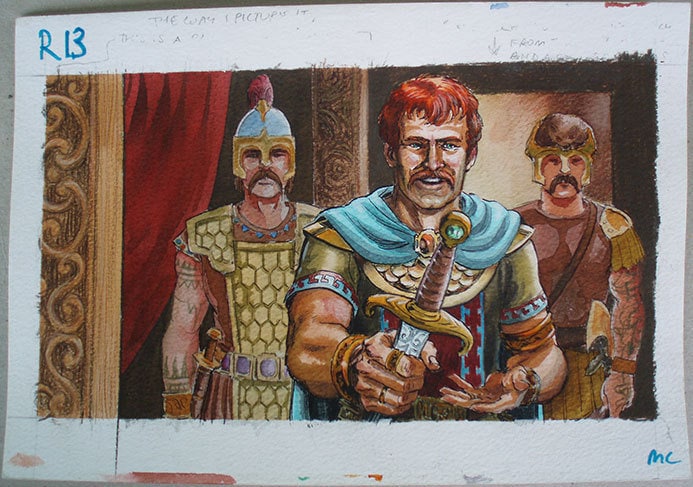
Rereading this morning the interview I did with David Dunham, the creator of the brilliant King of Dragon Pass (after blogging for five years I find myself forgetting the details of my own copy), it struck me that one of the things—besides the charming hand-drawn artwork, deep setting and challenging game play—that makes the game great and not just merely good is that it evolved in part out of two creative DIY-tinkering tabletop campaigns.
Clan Raiding scene [Source: King of Dragon Pass wiki]
If you remember (or if you are just tuning in) Dunham had played in the 90s in “The Taming of Dragon Pass”, a tabletop campaign run by Jeff Richards, chief editor of Glorantha's most recent home Moon Design Publications. That campaign ran off a home-brewed system called PenDragon Pass, a hack of Pendragon rpg and Runequest. (You can check out a partial version here on Dunham's website and a full version in Enclosures #1 if you are lucky bastard)

Mash-up seems inadequate, synthesis is the better word, as Pendragon Pass takes an unusual campaign premise, modeling small-scale “domain game” activity centuries before the usual Glorantha canonical setting, bending the elements of the two games with a great array of new subsystems and variant rules.

Here is a whole mini-game on cattle raiding, there an adaption of the Arthurian traits and glory system to a more organically Gloranthan system. You have the grafting simplified RQ magic system and the generations-long saga system of Pendragon noble family life into an Orlanthi clan system.

There's a simplified variant skill system working off of a d20 with a new skills appropriate to the colonizing/warring backdrop. The Enclosure version (yes, I know a lucky bastard) has a tight, interesting character generation system, an exploration mini-game and a bunch of other lovable chrome.

Fans of the computer game may recall a scene when some pre-Roman looking Briton types, exotic but still Orlanthi tribesmen from the distant west, come rolling up in open-walled chariots. That scene seems to be a bit of an easter egg homage to an East Ralios campaign by Dunham again using PenDragon Pass with further customization to fit the particular cultural and religious features of that other region.

Both accounts fire all my gaming pistons and strike me as a fully-realized vision of the kind of backwards engineering that me and my comrades in the DIY wing of the so-called OSR love to do: take crazy, individualized worldbuilding visions and bend, break and mutilate all the elements of our favorite games until they fit. (Sometimes the process works exactly in the opposite direction, with the mad tinkering informing the shape of the world, but I think you get my drift.)

That kind of spirit—when it works at the table—can create a vitality and freshness to the game. Further having some roots in the open “who knows what's going to happen” kind of play that is more typical of tabletop than that of the storyboarding lock-step of most modern crpgs grown purely in staff meetings.

Or maybe I'm just rationalizing breaking my self-imposed ban on computer games (again) as I fire up the PC version for the umpteenth time?  

Sunday, September 4, 2011

Return of the King (of Dragon Pass)

Readers may remember several months ago when I was waxing obsessive about the upcoming release of a smartphone app of the Glorantha-based computer domain-level game, King of Dragon Pass (an obsession that ran deep enough to seek out and interview the game's designer David Dunham).

Well that long-awaited day is now upon us, the app will be available for your downloading pleasure at the Apple iOS store this coming Thursday, September 8. The new release is promising not only some streamlining and updating but a host of new quests, treasures, artifacts, and other goodies.

Needless to say I look forward to eliminating all downtime sitting in grocery lines and long traffic lights by uniting the ornery Orlathni tribes under my bronze grip--if only virtually.  

Monday, May 23, 2011

Good and Bad News from Glorantha

First the “bad news” (suppose it could be good news depending on your perspective). It looks like Glorantha's Second Age is coming to an end...at least in its Mongoose incarnation.

In a recent announcement Mongoose stated:
We have recently announced that Mongoose and Issaries have mutually decided to part ways which, on the face of things, means no more RuneQuest and Glorantha (at least, from us). However, Mongoose retains ownership of the (frankly, absolutely cracking) core rules system which we intend to keep as our central fantasy roleplaying game mechanics. We will therefore be republishing the current RuneQuest II core rules as the Wayfarer rules system (as Traveller covers science fiction, Wayfarer seemed the logical choice for fantasy!).
Sounds too like the designer of MQII Loz, aka Lawrence Whitaker, is jumping ship to work with Moon Design Productions (the current purveyors of the more traditional Third Age Glorantha stuff). Whitaker's project for Moon Design is to design a supplement around the notorious anti-hero Harreck the Beserk in which players will "join Harrek as he sails around the world, sacking cities and pillaging them, fighting gods and stealing magical secrets, breaking ancient kingdoms and making new empires." Now that's unabashedly good news in my opinion.

Where does RQ and Glorantha go from here? What's the juicy backstory here?

On a side note, it's interesting that they have chosen to co-opt one of the homebrew names being used by people working on fantasy variants of Classical Traveller. Wonder if we will see some hybridization in the future? Personally I would find a RQ-like game with some creeping Traveller mechanics—especially with its characteristic mini-games like character generation—to be something really intriguing.


Now the “good news.” Looks like the smartphone adaption of Glorantha classic computer game King of Dragon Pass is getting closer to completion. Game designer David Dunham has said recently on his design that he was working on the last step of putting together a new manual—and opening a second round of testing.

BTW David is selling some of the gorgeous original artwork from the game here on Etsy. Your chance to get some wonderful work and help support the man driving this project. (I got the above piece titled “Rival Council” from him last week in the interest of full disclosure.)

A busy week ahead for me here as I clear out this backlog of half-baked drafts for this blog–and try and juggle an intense real-world political campaign.  

Monday, April 18, 2011

What Tékumel Could Learn From Glorantha

Tékumel fans have been making a lot of noise recently around a perennial subject: how best to revive M.A.R. Barker's almost-famous setting. The rarefied, usually-quiet Tékumel list is a-thrum with exchanges over what product vehicle would best spark said revival.

Most seem to be advocating for a switch to a modern, bigger-tent game system (d20, Pathfinder, or Savage Worlds), others pushing for a system-neutral re-release of source material or a sprucing up of the primal game system Empire of the Petal Throne.

While my sympathies lean to the latter camp, I find myself wondering if any of these noteworthy projects are enough. Could any of them on their own weight deliver this lovingly baroque, sword-and-planet world to a broader audience?

I am certainly no expert myself on rpg product development—and it's really a very foolish person who looks to me for my unsolicited armchair advice—but I keep thinking that Tékumel needs something broader and more ambitious if it wants to widen its niche. To be exact, I keep hoping that Tékumel took some cues from the recent history of its distant cousin, Glorantha.

Tékumel and Glorantha share a good deal in common on the face of it.

Both settings sprung Pallas Athena-like from the heads of brilliantly creative--and detail obsessed—single creators (Barker and Greg Stafford) years before a game could give them expression. Both evolved in the 1970s variant game systems out of the OD&D mothership (EPT and Runequest)—and both posited (and delivered) themselves as much deeper explorations of fantasy worlds than vanilla D&D. Both of them also wandered in the wilderness for a while intellectual property tangles after their respective heydays-- EPT after being cut loose from TSR and Runequest after the Avalon Hill debacle.

But for all those similarities Glorantha fared better.

While its public profile is still pretty modest even by the diminished standards of the tabletop rpg hobby today, Glorantha does have some kick to it. It has, for starters, not just one living game, but two. Instead of detracting from each the two game lines seem to complement each other by satisfying two different fan niches: Mongoose's confusingly-titled Runequest II for the lovers of the game system proper and Heroquest for the hardcore, narrativist lovers of Third Age Glorantha. Tellingly both games are pumping out a stream of attractive new products.

Meanwhile on the side you have an almost-bewildering array of clone projects giving other living game platforms for people interested in gaming that world: the streamlined RQ-lite systems of Openquest and now Doomquest (thanks to the Stafford-dedicated recent issue of old school zine Fight On!) ; the high crunch of Steve Perrin's SPQR, or the abstracted new edition of BRP.

On top of all that you have the (perhaps soon) re-release of one the best introductions to Glorantha ever devised, the computer strategy game King of Dragon Pass. By virtue of being a computer game—and a smart-phone app to boot—its highly likely that it will help bring audiences back around the setting than any tabletop game, no matter its success in this period, could ever muster.

Thinking of all those things I find myself dreaming about a similar revival for EPT. Something like...something like...

[Now you have to imagine here a dreamy harp playing and the camera lens shaking around to signify a Gilligan's Island-like dream sequence.]

...Something like if you took all the stirrings of the current contemporary Tékumel corners and yoked them to revamped historical legacy projects for a full-court press aimed at the returning tabletoppers of the rpg “Baby Boom” of the 80s.

Let's parse out that mouthful.

What if you started with two new-old living games. Say on one level for the old system-lovers you took the old EPT rules cleaned them up, reformatted them, and added in some new art here and there. It's not an audience of the thousands that some seem to have stars in the eyes for, but an attractive OD&D variant game is highly likely to attract an audience in the hundreds (yes, let's be real). And hell the rules are already written.

Now if you really wanted to be ambitious with that audience you could start to release a few high-profile supplements I believe guaranteed to have as much appeal as the rule set above: the much-coveted Jakallan underworld, the lengthy and excellent Swords & Glory sourcebooks; perhaps even a porting of the deep, interesting Temple-based magic of S&G.

On the second level you could have another living game for the hardcore based on an even-simpler system: the super-lite, almost rule-less story-focused mechanics that Barker himself used for a time. (Ironically of which I first read in the program book of a Runequest convention.)

And now here's the other pillar that I think is as just as necessary as the products above—or more—an explosion of creative hobbyist energies canonical and not around the setting. 

Here we can already see the seeds: the creative, consistent play and preservation efforts of the Aethervox Gamers up in the tundra; the Tekumel Project's excellent, drop-dead gorgeous range of figures; Victor Raymond's runnings of Jakallan underworld games at recent conventions; The Drune's efforts to expand the space opera pre-history of EPT into a fully fledged game of its own with Humanspace Empires; and the list goes on (and my typing hand tires).

Idle, pointless dreams perhaps, but hope does spring eternal.  

Tuesday, March 15, 2011

We Need More Gaming Art Like This

Caught this one today cruising around looking for Glorantha arcana. The artist is the sci-fi novel cover artist Richard Bober for depending on the sources either the never-published supplement Dragonrise or for the also unreleased Runequest IV, Adventures in Glorantha (though more reputable sources seem to point more to the former as the source). 

Monday, February 28, 2011

What Makes a Great Fantasy RPG Map Great?

I spent a good portion of my weekend (when I wasn't marching up and down the square) thinking about maps. Cartographic love runs deep in many old-time rpgers and I am certainly no exception. In fact the powerful draw of maps preceded my entry into the hobby and maintained itself even for the two decades I was out.

Where does that power come from? What features of a great map make it great?

Let's take it apart.

A great map provides both a cerebral and visceral experience. A great map doesn't just tell your brain the necessary practical facts to help run a gamelike how many hexes it is from Nyrond to Rauxes—it hits you in the gut too. It evokes a feeling or mood, the fleeting sensation of a world that might have existed.

There was some back and forth in the comments on Saturday's post about how hand drawn (and hand inked as Scott Pasha added) tend to be more powerful than even beautifully done computer-generated ones. My guess at the why is that a hand-drawn map creates more of an illusion that a map is a product of the world it represents.

A computer-drawn map talks to your head. It's precise, a useful tool to help you effectively run a junket through the wilderness—but it misses that gut pull completely.

Feel the difference in the two following maps of Harn.

Great map:

Good map (but missing something right?):


A great map tells a story about it's setting. It visually pulls out elements that are critical to that setting and influences what is important to a reader.

Each of those five maps I listed on Saturday immediately told me something about the setting before I even cracked open a related gazetteer.

Church's maps graphically highlight features that seem imbued with myth and mystery—hallmarks of Glorantha. What is that gigantic monolithic block rising three-dimensionally from the page? Why is there a swamp pooled at it's base?

The flowing alien-seeming Tsolyani script and symbolic on-map caricatures of deities instantly transport a viewer to the exotic environs of Tekumel. Skeletal Sarku leers from the City of the Dead. (Sadly this is only of these maps that uses the kinds of depictions of people, monsters, ships, etc. common on medieval and ancient maps to build mood.)

The eye-catching prominence of tracts of wilderness in Darlene's Greyhawk maps jump off the page. Long stretches of dark-green heavy boreal forest and heavy black ice made me instantly want to know what this Blackmoor was. How wouldn't see the jagged bands of thick chocolate-brown mountain peaks surrounding the Valley of the Mage and want to immediately pack up some mules to investigate?

A great map uses color and negative space to contrast elements. Notice in Darlene's map how the wide, green spaces that make up each nation make for a subtle contrast with those wilderness areas I mention above. There are no heavy border lines just beautiful terrain brackets.

Though Church's Prax map is black and white, it's lack of color is almost a virtue because of it's effective use of white space and his shading detail for terrain features.

A great map uses fonts that are appropriately sized and chosen for feel. Map text doesn't dominate any of those five maps. We have all seen those maps where text virtually clutters the whole thing for a busy, busy mess that exhausts you just looking at it.

Contrast this recent Dragon Pass map with Church's to get a sense of the defining differences to both those features above.

Good map:

Great map:


Saturday, February 26, 2011

Top Five Fantasy RPG Maps

Rob, the protagonist of High Fidelity, claims early in the novel that you can judge the character of person by their responses to Top Five lists. Such lists are part of the stock trade for lazy day blogging. Who am I to resist the call?

What are your Top Five? I promise not to judge. Much.

In reverse order:

5. Dying Earth RPG maps by Sarah Wroot. The color and skill of these maps thrill me. They are some great whimsical touches on the street level maps of Kaiin that at times sell me on the Vancian feel more than the RPG itself.

4. Bey Su city map from Empire of the Petal Throne by M.A.R. Barker. It wasn't until my second time around in Tekumel fandom that I realized that the cover of EPT was a map by the professor himself. Bonus immersion points for a map more symbolic than geographically accurate (if anything what most maps drawn in our dreamworlds would look like to the inhabitants themselves).

3. William Church's Prax map from Runequest II (the first one that is). No other map captivated me into wanting to know more about a setting than this one (remember that the details of Glorantha were pretty sketchy for those of us who had only that rulebook as an intro).

2. William Church again sweeping the list with the map from Dragon Pass. OK this is a bit of a cheat since it's technically from a boardgame of Glorantha, otherwise I'd be tempted to put it in #1. Click to enbiggen to get the full effect. 

1. Ah, the all-time classic and nostalgic favorite, Darlene's map of Greyhawk. Other kids had posters of Dallas Cowboy Cheerleaders and ferraris, I had this one up on my wall—where it reigned for four years until a Black Flag poster came along to kick it off.

Tuesday, February 22, 2011

How Best to Game Glorantha?


As some of you have noticed I have been on a bit of Glorantha/RQ kick as of late. I've really been interested in exploring all the new iterations of the settings and the rules.

RQ second edition (the old school Chaosium one that is) and the third are pretty much where I left off, and frankly looking around I am totally overwhelmed by the crazy-quilt amount of options these days. You've got Hero Wars, Heroquest, Openquest , Mongoose's Runequest (first and second), Steve Perrin's Quest Rules , Runeslayers, BRP, GORE, etc. 

Sweet screamin' Orlanth! A seemingly never-ending menu of choices I found once I opened the lid on this thing.

So for a casual, on-again/off-again lover of RQ2 and Glorantha--who tends toward the older school, lighter end of rules--what do kindly folks out there suggest and why? What are the strengths and weaknesses of each? What's crap and what's gold?

Can a kindly Glorantha-phile help a brother out here?

Saturday, February 19, 2011

Interview with the Man Behind the King (of Dragon Pass)

Today we have a special treat, an interview with David Dunham, the leading light behind the Glorantha -based computer game King of Dragon Pass

Released in 1999 the award-winning game continues to be highly regarded by many rpgers for its immersive gameplay and gorgeous hand-painted scenes. I myself believe it to be the single, best introduction to Glorantha for newcomers.

Look for a follow-up post here analyzing some of the game's strengths and what we can take away from it in our tabletop game.

Hill Cantons: Let's start with introductions. How would we best introduce you? As the owner of A Sharp and lead programmer of King of Dragon Pass?

David Dunham: I was producer, lead designer, and a programmer for King of Dragon Pass. That meant I was responsible for finding a team of very talented people to help design, create, and test the game.

It turned out that A Sharp published the game as well, which meant I got to make packaging decisions and do the marketing. Sadly, marketing is not something I'd call a strength.

HC: You have some background as a fan of Glorantha. Your related PenDragon Pass variant rules I found personally very interesting. What was your connection to that setting?

DD: My first exposure to Glorantha was actually in the late 1970s, with the board game White Bear & Red Moon. I didn't really appreciate it as a setting until I began playing a RuneQuest game in 1980.

One of the advantages of the tabletop RPG hobby is that it's very easy to get involved as a creator. I wrote for various magazines, which I think is how I first ended up corresponding with Greg Stafford, the creator of Glorantha. Greg also created Pendragon, an elegant RPG that featured saga-style play: a campaign was intended to span many game years, and involve the children of the original player characters. PenDragon Pass was my attempt to bring that style of game to Glorantha. The multi-year nature of the game seemed to fit well with the resettlement of Dragon Pass.

My original campaign was cut short before the multi-generation nature came into play. Years later I got to play in Jeff Richard's “Taming of Dragon Pass” campaign, which used the PenDragon Pass rules. It lasted long enough for many of the characters to die heroically so that their children could live, and we continued as children of the heroes.

After KoDP, I was asked to do art direction for the Hero Wars and HeroQuest product lines (those being the Robin Laws game rules designed for Glorantha).

I haven't played continuously in Glorantha, but it's such a deep setting that I keep coming back to it. Usually I explore time periods or geographies that aren't the core setting. (My notes for a Second Age game were passed on and used as part of the background for Mongoose's RuneQuest.)

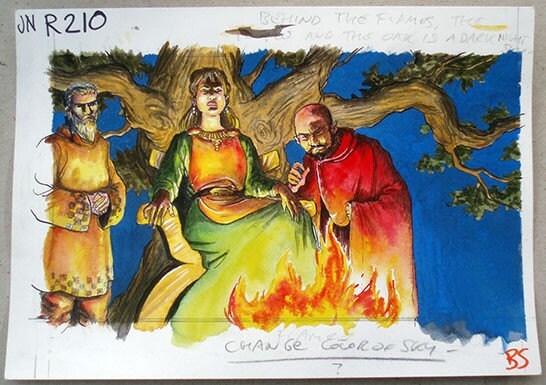
Original artwork from the game 
HC: How did KoDP come into being? Who was driving it and what were the goals? And how did all that beautiful artwork take shape?

Greg Stafford and I were corresponding, and both of us seemed to be on the same page as far as what we'd like to see in a computer game. He was amenable to licensing, and realized the different needs of a computer game, compared to an rpg. A number of things then fell together, and I was able to get Robin Laws as writer and Elise Bowditch as Associate Producer and multimedia developer.

There were three main goals. The first was to do a storytelling game--this seemed like a relatively unexplored area of computer games. I'd really liked what Scott Bennie did in Castles, but I thought it hadn't gone nearly far enough. Second, I wanted to create a game that, like an Icelandic saga, spanned generations. And third, set it in the amazingly rich world of Glorantha. Which again suggested the resettlement of Dragon Pass.

As I said, I was driving the vision. In particular, I need to create a shared vision, since Elise and I were working out of our house, and planned to hire contractors. I made mockups of some of the game screens, and found an artist to do better renditions of them. As we found additional artists, one of the first projects was to create a style guide. What did the Orlanthi look like? Would we be able to distinguish them from Orlanthi from elsewhere?

One of the consequences of using Glorantha was that I wanted to include heroquesting, which is not only cool but a distinctive feature. So I wanted an art style that made it obvious you were in the word of myth. We ended up picking Mike Raabe, whose portfolio included Magic: The Gathering cards that had the right look.

The bulk of the game was planned for a graphic novel style of art--high quality, but something that could be produced relatively quickly (since so much art was involved). We ended up going with Stefano Gaudiano, who'd worked in that business, and who also knew a team of pencillers and colorists.

Finally, the game also portrayed the distant past, as well as the future. For that third art style we used Damon Brown. His woodcut style art was obviously different from the other two.

Basic art direction ("a guy on a horse threatens two thralls") usually came from Robin Laws, sometimes from me. I'd polish it, and turn it over to Stefano Gaudiano, who would come back with a quick thumbnail (often using an artist who was really good at layout). Elise Bowditch and I would review these.

Rarely we'd send one back, but usually they only needed minor changes, and Stefano or one of his artists could make a pencil sketch. Elise and I again reviewed these, then Stefano would ink them and give them to a colorist. He'd then add additional detail, and scanned them and made minor tweaks in Photoshop. The process was similar with Mike Raabe and Damon Brown, though Mike did his own colors.

HC: Why did you want to revive KoDP as a smart phone game? Where is that project at currently?

DD: King of Dragon Pass came out in 1999, and while it's still possible to play it today, the Windows and Mac machines of today can have a harder time running it than when it was new. I was also looking for an iPhone project I could do for a reasonable budget. That beautiful artwork was the biggest cost for the original game, but it was already paid for. And 2/3 of the game code could be reused with only minimal modification.

All I'd need to do was rewrite the user interface code...

That took longer than expected, which in retrospect shouldn't be surprising since it was the bulk of what Elise did for nearly three years. On the one hand, it was easier, since there was already a working model. On the other, a lot of it needed to be reworked for the small screen. I worked with Jani Lintunen on this.

I also wanted to make some improvements to the game, since I've learned both from KoDP and eight years at GameHouse. And selling in today's market pretty much requires some sort of social connection (Twitter, Facebook, Game Center).

At the moment, the UI work is complete (other than adding a list to the in-event raid dialog). I'm still finishing up the new work. Once that's done, the game will need testing before it can be released. I'm afraid I can't give a specific timetable, but you can watch the progress at our development blog or follow @KingDragonPass on Twitter or ASharpLLC on Facebook (did I mention the social connection?).

Wednesday, February 16, 2011

Glorantha Coming to a Phone Near You

Smart phone-owning fans of Runequest (and successor's) home setting, Glorantha, are in for a treat. Programmers are busy putting the final touches on a Iphone and Ipod Touch compatible port of the classic 1999 roleplaying/strategy computer game, King of Dragon Pass

The app is slated to be released in “early 2011”. You can check on progress yourself at the project's blog here.

I will be sitting down and writing a longer post tomorrow about the game's rich, imaginative game play—and what we tabletop rpgers can learn from it when expanding our own domain-level play.