Showing posts with label worldgame. Show all posts

Tuesday, October 4, 2011

There and Back Again with the Domain Game

Maya Angelou once said that achievement was its own anti-climax. Hitting that last final control-S and closing out that nagging master document that has been sitting open on my desktop for more than half a year makes me feel a lot more out-to-sea than it does triumphant.

Yes, there's a lot still to do on the backend of the Hill Cantons: Borderlands project--editing, editing and more editing, art direction, layout, and promotion—but the longest truck haul is over. I should feel like breaking out the bubbly, instead I keep hearing the call of a little red pitchforked scamp on my shoulder whispering, “keep trucking, Chris.”

I am restless by nature and this entire project was built on exploration of a little-traveled area—domain-level play. The play of the Domain Game itself--supercharged with the ramped-up imaginations of the 20 players that touched it--generated the contours of the Borderlands, much more than the refining and revising playtesting of the last few months (valuable as it was).

Plain and simple, now that I have gotten to the edge of the map I want to go on to the next edge.

To be sure there's a lot of off-road play to still be had with this stuff, I kept dumping sub-sections like ballast to get the whole project done on a reasonably timely basis. The cutting room floor has a number of things I still would like to see hothouse and there were paths opened in the first round of playing never even explored.

I am especially interested in getting a holistic thing going—putting the Middle Game/Pendragon D&D whirly bits together with the domain-ruling and mixing it with some ideas I have about deepening sandbox campaigning.

Now here's the open invitation to come sail off with Mad Captain Kutalik again. Based on past experience I am going to start on the modest and low-key end see what builds from there.

The nitty gritty:
Monthly “face-to-face” game. The main play arena will be a monthly video-conferenced game run on G+ with a rotating cast of four-six at a time.

Two levels of involvement. At the higher commitment end I am looking for one or two (maybe three if there is interest) players who will be the “primary cast”. These players will need to be able to make most if not all the monthly games and will play high-level “lord” characters. They will be the “deciders” around a limited range of domain rule and there may be some limited email exchanges about inter-session housekeeping with me between sessions.

The second level is for more casual players and here I am taking a more-than-merrier approach number-wise and are invited to play as much or as little as they like. Players here will make a mid-level character that will be either inactive or run as an NPC at the session proper.

Both levels will play together in the monthly sessions.

Co-Creation. We are going to start with a relatively blank slate type carved-out-of-the-wilds domain—though one that has been able to sink enough roots to harbor some intrigue. One thing I learned that if you let some of you maniacs loose with creating the details you come up with some jaw-droppingly fun and interesting details, so this we will repeat (albeit on a more collaborative, lesser scale).

Rules. Here I leave it up to the will of the readers—at least as bounded by my two-party duopoly.

Blue Party: The stolid old warhorse choice. OD&D plus Greyhawk possibly with some choice bits from Adventurer Conqueror King.

Red Party: The odd-ball party of “change”. Stormbringer, first edition with a raft of house rules naturally.

Both parties will of course make use of the Borderlands existing and cutting room floor sections.

There is of course a lot more to be said. If you are interested or have questions drop a comment here or email me at kutalik at the gmail dot com.  

Monday, February 21, 2011

Follow-Up Interview on the German Worldgame Magira

A major theme that has developed on this blog is that of the beauty--and yes, fun--of a shared world-building experience. Invariably when talking about Tekumel or Glorantha is the comparison of those world's broad, expansive visions to that of Tolkien.

But what those observers often don't get, or at least state, is that the nature of gaming in a world, even ones that have fine level of detail courtesy courtesy of a single creator and final authority, invariably makes that world a collective experience. Hundreds of Tekumels and Gloranthas have existed in varying degrees of canonical imitation.

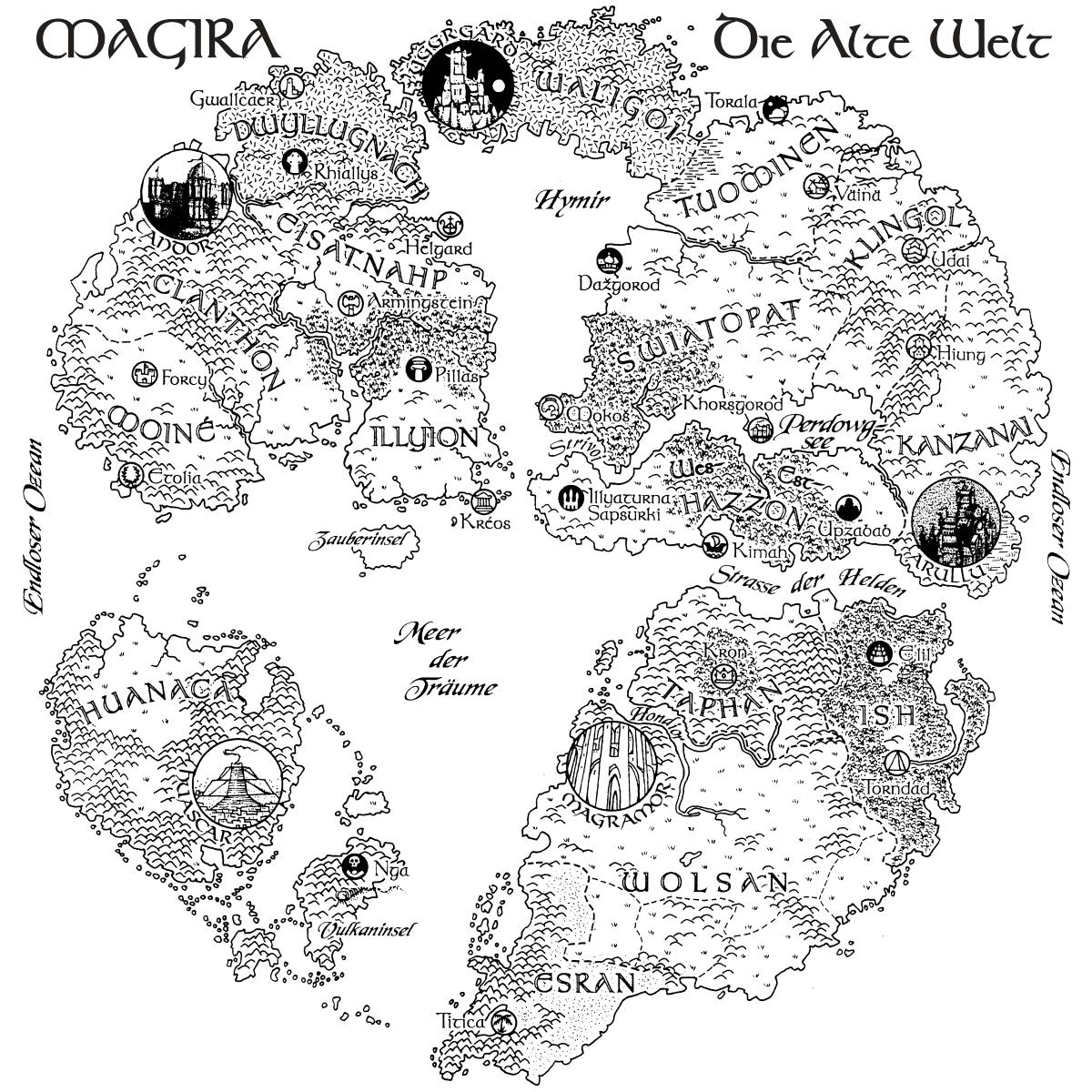
What I find most interesting about our recent exploration of the German-Austrian worldgame Magira  is that since 1966 this world has allowed thousands of participants a chance to build a corner of that world—and as you will see in this following (pun somewhat intended) interview a chance to fight for your collectively-shared nation in that open world.

Thanks to the recent articles here on Magira I received some great and helpful responses from German readers. One of them was from a long-time participant in the fantasy society that founded Magira, the Fellowship of the Lords of the Lands of Wonder (FOLLOW). His “character name” in Magira is Dhokaj.

Hill Cantons: Can you tell me about the history of FOLLOW? How did it start? What were the society's goals?

Dhokaj: FOLLOW was founded in 1966 by Hubert Strassl (aka Hugh Walker), Eduard Lukschandl, and Axel Melhard. They wanted to create a club about fantasy literature (which was practically non-existent in Germany at that time).

They also had the idea of a structure that resembled medieval European society with its nobles and knights. They wanted to have a hierarchy in which you could rise by being active (writing stories, etc.)

Therefore they founded “Clans” that represented realms, nations or civilizations. Each Clan had a “Lord” or a “Lady” who was the leader of the clan (the top of the hierarchy) and a crest, normally with an animal as a symbol.

HC: How did Magira start? When and how did Armageddon and other games begin?

D: The first Armageddon boardgame took place in 1968. This marks the beginning of the world Magira and of the Ewiges Spiel, the “Eternal Game”, that is still being played today. They needed a game plan and created the Old World of Magira (the one you posted in your blog) as a hex map for that purpose.

So Magira is a fantasy world that contains the civilizations that are represented by the Clans. Each Clan has the right to take part in the Eternal Game to defend its territory or to wage war on others.

Each member of a clan represents a personality of the people that is simulated by their clan. But this is not a role playing approach in the form of rules. It is more a literary approach, so the personalities could be a slave on a galley, a mighty demon or a skilled bard–this depends on the clan you're in.

An assault on the Citadel of the Gods in Armageddon

HC: Who is involved with FOLLOW and Magira in current years? What kinds of activities do you do?

D: At the moment Follow is made up of 78 clans but not all of them are active and not all of them are taking part in the eternal game. But the Eternal Game is still being played once a year for three days and what is played is the basis for the political structure and the historical development of the world Magira.

There are roughly 400 to 500 fellows (members of FOLLOW) and the clans range from 1 to 40 members.

The activities cover a very wide range from playing Armageddon to creating costumes, writing stories, composing and performing music, role playing and so on.

Thursday, February 17, 2011

Settling the Wilderness

Work still continues on the King of Dragon Pass post. Reinstalling the durn thing on my hard drive proved to be a foolish, foolish mistake. Fired up a game last night and several hours went poof. (There is a reason I eschew computer games for tabletops ones in the past five years.)

As penance, I am sharing another freebie subsystem from the Domain Game, in this case guidelines for attracting denizens to your newly-carved lands.

Note that I still want to add a few things to these guidelines notably some ways to model attracting more urban types (craftsmen, merchants, clergy, and the like), rural un-landed workers (fishers, foresters, cottars, prospectors, etc.), and “out-of-the-box” emigres (demi-humans, non-humans, nomads, etc.).

Any thoughts from the peanut gallery?

Colonists
Colonists are attracted to your realm by the promise of free or cheap land. Colonists work their own land and provide their own means, thus the player-lord has no direct obligation to house, feed, and pay them as they do for their retainers, hirelings, and followers.

Every three months a call can be issued to a friendly adjoining civilized area. With each seasonal call, the player can grant and settle up to 1d6 square miles of arable land (+1 can be added for 200 gp spent on advertizing and inducements).

Granted or purchased land must be reasonably secured (regular patrols and no outstanding monsters or other threats) subject to the GM's ruling.

For each square mile granted roll:
Roll d10
1 none
2-3 16 families of tenant farmers
4-5 14 families of tenant farmers, 2 families of freeholders (80gp for sale of land)
6 12 tenant farmers, 4 freeholders (160gp sale)
7 12 tenant farmers, 4 military colonists
8 10 tenant farmers, 2 freeholder (80 gp sale), 1 gentry (160 gp)
9 10 tenant farmers, 2 military colonists (160gp sale), 1 gentry (160 gp)
10 8 tenant farmers, 4 freeholder (160gp sale), 1 gentry (160 gp)
*Any emigrating family can be substituted for a family of tenant farmer if desired.

Modifiers:
-8 extreme conditions
-3 harsh climatic conditions or poor soil
-2 land has been secured less than a year
-1 below average soil

+1 good soil or other pleasant terrain conditions
+1 land has been secured more than five years
+2 extremely fertile soil

Tenant Farmers
Free farming family that works a leased grant of 40 acres in exchange for farming work, militia service, and taxes. Typical family will be five with three working bodies that are available to work the landowner's seeding and harvest. The household will provide one unarmored combatant with club, dagger, or other makeshift weapon.

Freeholders
Free farming family of five that works a purchased grant of 40 acres. In an emergency situation, the household will provide one combatant with leather armor and a bow, spear, or other culturally-specific weapon.

Military colonists
Family headed by soldier/mercenary/warrior that works a leased grant of 40 acres in exchange for militia service. The household will provide one combatant with ring or scale armor and a polearm—or equivalent culturally-specific weapon and armor.

Gentry
Wealthy, but not titled landholder that purchases 120 acres. One family of five with 12 servants. In an emergency situation, the household will provide one mounted warrior with chainmail, shield, sword and lance—or equivalent culturally-specific weapon and armor—and three unarmored combatants with club, dagger, or other makeshift weapon.  

Tuesday, February 15, 2011

Foraging and Farming Rules for Classic D&D

Housing is not the only thing that the Domain Game expeditions are hurriedly throwing their energy into, the all-important task of hustling enough food out of the land to survive and thrive is another central arena.

Below are some more domain-play rule guidelines for handling foraging and farming. The agriculture rules will undoubtedly gain a good deal more detail as I expand the list of available crops beyond the simple grains modeled below.

These guidelines like yesterday's construction rules are a work in progress. Feedback is appreciated. 

Hunting and Gathering
Hunting and gathering can be a short-term fix for the food problem. A full-time hunter/gatherer can maximally sustain 4-16 individuals (including himself). The rate varies according to the abundance of game and other wild foodstuffs in a hex—and the skill and technology of the hunter.

Things to keep in mind with this activity:
  1. That you can only sustain a relatively small group of individuals in a locale. Thirty individuals for each adjacent five-mile hex of the hunting grounds. (Thus if you had a base camp area that hex and available hunting grounds in the surrounding six hexes could sustain up to 210 people in that area).
  2. The maximum rates are adjusted by season and climatic events. Game and other forage will be difficult in winter in cold climes or scarcer in a dry season in a more tropical one.
  3. Hunting at the maximum rate is not sustainable over time. Over several months of this activity the area you will have chances of declining yields due to over-hunting.
  4. This being a fantasy rpg there is always a chance that your hunters will encounter creatures other than what they are hunting out in the field.
Farming
All farming is conducted on a square mile basis (640 acres). Each five-mile hex contains 21.65 square miles.

However, not all land in a hex is arable. The GM will determine the number of square miles that are tillable in each hex (medieval manors had about 20-40% of available land under cultivation).

An average harvest of the “Big Three” mixed grains (wheat, barley, and rye) will support—after re-devoting seed back into the land—the equivalent of 186 people for a year. The harvest can also be converted into 4,480 bushels or 9,672 food/weeks for game purposes.

A minimum of 40 laborers is necessary to have a decent harvest, 64 is optimum. Throwing on more workers will improve yields up to a point.

Roll d20
1 or less Disastrous 50%
2-3 Poor 70%
3-6 Below Average 80%
7-14 Average 100%
15-17 Good 120%
18-19 Excellent 150%
20 or more Miraculous 250%

Modifiers:
Tech level
-8 Tech level 1
-2 Tech level 2
+1 Tech level 5
+2 Tech level 6
+3 Tech level 7

Magic
+1 for every two Druids 3-5th level assigned
+1 for each Druid over 5th level assigned
+1 for each Cleric over 5th level


Monday, February 14, 2011

Construction Rules for Classic D&D

We are well into the second month in the great blank-slate world of Nowhere, and Domain Game players are busy taming—or being tamed by—this brave new world. While cyclopean ruins, mysterious golden barges, vast metal domes, white-furred apes, and other oddities have beguiled the expeditions from Elsewhere, they are making a go at the more prosaic job of settling into their new dominions.

Everywhere is the sound of hammers, saws, and the rest of the general din of construction. Ziggurats, longhouses, towers, stockades, mud huts are slowly and surely being raised in this howling wilderness.

And as goes the flurry activity so go the gnomes behind the scenes working to ensure the smooth flow of the natural laws of the new world—that is the in-game mechanics for the larger rules supplement project.

For the rest of you we give you this today: construction rules for your classical D&D game. For the full version including road construction, underground excavation, and all the lovely modifiers that give you that fine crunch you can find it here as part of the revised rules guidelines (including some other rules for would-be overlords).

Construction
To build a structure:
  1. the type of structure(s) to be built
  2. The number of ten-foot square cubes to be built of that structure
  3. Number of workers assigned
  4. Where the materials are to come from etc.
Example: Margrave von Schadenfreude wants to have 50 followers start working on five small one-story wooden cottages that are 10 feet by 30 feet (3 cubes).

Since the Margrave's project is in a wilderness area, he will direct another group of his followers to harvest the needed materials directly. Thatch from the grasslands will be used and timber cut from the adjacent light woods.

Total labor time for the project is 480 worker/days (15 cubes x 32, the base-rate for an average wooden structure). Since he has 50 workers on the project it will take them 9.6 days (480 divided by 50) to complete building the cottages–barring any delays.

Baseline Cost and Time
All work based on 10'x10' “cubes”. All prices applicable if structure is in a borderlands or civilized hex. Substitute gp equivalent amount of materials for wilderness area.

Any building over two cubes must have at least one semi-skilled worker for eight cubes. Any building over 24 cubes, must have an engineer or architect assigned for every 48 cubes.

Material
Price per Cube
Construction Time
Primitive 10 gp 25 worker/days
Mudbrick 20 gp 30 worker/days
Wooden 30 gp 32 worker/days
Brick 110 gp 90 worker/days
Stone 140 gp 160 worker/days

Quality level
Building is assumed to come with basic furnishings, roofing, and flooring appropriate to the quality level. Additional or unusual furnishings must be purchased separately.

Cheap 75% price/time
Average 100% price/time
Comfortable 150% price/time
Semi-Fortified 200% price/time
Luxurious 250% price/time
Fortified 300% price/time

Vertical building
Second-story building is free. Add 25% to the cost for each additional story.

Misc. Structures

Amount
Cost
Construction Time
Wood fence
10' length, 6” wide
20 gp
5 worker/days
Wooden palisade
10' length, 2' wide
80 gp
25 worker/days
Ditch
10' length, 10' wide
60 gp 20 worker/days
Abatis
10' length, 3' wide
40 gp 10 worker/days
Earthworks
10' length, 5' wide
60 gp 15 worker/days
Stone curtain wall
10' length, 5' thick 250 gp 100 worker/days
Reinforced door
1 panel 40 2 worker/days
Portcullis
1 panel
600
15 worker/days
Secret door
1 panel
400 20 worker/days

Friday, February 11, 2011

Map and Links for Magira and Midgard

Unfortunately nearly all meaty information for things Magira and Midgard is in German. For all us hapless non-German speakershey, if it was in Spanish, Czech, or Slovak I would have it already covered—I am working on getting some translations up in the following month or two.

Big thanks to the kindly folks who have already stepped forward to help—we can always use more.

Links:
Empires of Magira and Adventures in Magira here 

Midgard here  and here 

FOLLOW (the fantasy society with Tolkein leanings that kicked this off) here 

Armageddon (the complicated massive mini/board game pictured below that has some continous games reputedly lasting over 30 years) here and here (English info, linked to yesterday, here )


Thursday, February 10, 2011

How Empire of the Petal Throne Helped Birth German Roleplaying

Yesterday, Irbyz threw out a tasty bit in his comments here about the worldgame Magira that can't be ignored by a Tekumelphile like me.

Magira is a complicated multi-layered business. First created as an open-world fantasy experiment in the 60s by the German-Austrian fantasy society FOLLOW (Fellowship of the Lords of the Lands of Wonder), it remains running in a diminished form to this day. Magira has been built in the imaginations of its thousands of participants in a crazy-quilt variety of ways: miniatures/board hybrid games like Armageddon, play-by-mail games, collective fiction, LARPs, costume play, and, yes, tabletop rpgs.

Indeed, I had read several times over that the worldgame didn't just spawn an entry into German-language role-playing, it spawned the first commercially-available German pen-and-paper rpg game. Arriving in 1981 as a thick 216-page manual, Midgard has chugged along up to the present through four editions. Like many second-generation American fantasy rpgs of that era the game has been described as evolving from a variant D&D into an increasingly more complicated system.

I had also read a few times in passing that M.A.R. Barker's Tekumel had had some influence on the Magira experiment and always assumed that this influence was in the world-building department. Much of the world's collective identity had been created by it's many players who had assumed commanding positions in the various player-founded imaginary nations. Most of these nations had stand-ins to real-world equivalents and like Barker, the influences of India and China prevailed over western European.

I was wrong.

Actually I was wrong twice over in my assumptions. I was wrong about Midgard being the first German rpg. Midgard's author, Jürgen Franke, it seems had released a small-circulation set of rules titled Empires of Magira in 1978 that should be awarded that distinction.

Turns out I was wrong too about Barker's influence. Empires of Magira wasn't just influenced by Empire of the Petal Throne's world-building, it was EPT. Literally.

At first glance, parsing through the garbling of a Google translation it looked to me like Franke had adopted a few rules from EPT here and there--percentile-based attributes, spell names, torch-bearing slaves, “eyes”, etc.--maybe even lifted a few Sutherland illustrations (see the EOM pages right).

Noticing the handful of rule section numbers and their corresponding themes, I compared them to the original EPT rulebook. Sure enough they were all direct matches. In fact,  Franke didn't even bother to translate into German certain English terms like "hit dice" and "damage dice".


Seems EOM was basically that very thing a few small group of old schoolers have been kicking around recently, an EPT clone divorced from Tekumel.

Interestingly, Midgard (which separated itself from Magira in 1987) looks like it contains trace elements of its EPT origins, such as percentile attributes, to this day.

And that my friends is at least part of the story about how EPT wasn't just the first link in the chain of English-language Tekumel games, but helped spawn a lasting line of games on the other side of the pond. 

A big hearty thank you to Irbyz/Harami/David for his yeoman's work in digging up this (and other) stuff in the first place.   

Monday, January 24, 2011

Works in Progress

[Editor's Note: the seventh point was inadvertently omitted in my original post. Added now post-facto.]
Today an update on the status of the Domain Game supplement itself. The PBEM experiment game seems to eat up way more time than I expected (though I complain not—still hella fun), yet somehow I do manage to make some headway.

Through the end of this month and the beginning of the next you can expect to see me release several of the play-test rules selections that I have fleshed out so far. I believe that even in their draft, non-integrated state that some of the sub-system pieces will have utility for GMs in their regular campaigns.

These are the most likely candidates for so far:

1. One Equipment List to Rule Them All
  • Large-scale expansion of civilian goods
  • Geared to different tech levels and rural/urban market availability
  • Bulk item purchase guidelines
2. Personnel Price List
  • Wage costs of unskilled, semi-skilled, and skilled professions
  • Costs for slaves, serfs, convicts, and indentured servants (nasty business that it is)
  • Geared to different tech levels and rural/urban market availability
3. Natural Resources
  • Mundane, special, and magical resource allocation by hex
  • Rating system for the quality/quantity of resources
  • Exhaustive lists of each resource indexed to market worth and special usage
4. Sub-system for trading and trade goods
  • Integrated with the above-mentioned Equipment List
  • Rules for both micro and macro trade
5. Construction Rules

6. Swords & Shields Fantasy Supplement


7. Domain-level Ritual Magic

Friday, January 21, 2011

News from Nowhere

I sat on the William Morris allusion in the header for too long, today it has a good fit and thus it finds gainful employment.

A veritable din of Domain Game activity this week, a few news briefs:

Round One Closed. I have been getting numerous inquiries about joining the game--five in the last two days alone. While I am encouraged by the level of interest, I simply can't accommodate anymore players in this round. But weep not, there will be spaces in the rounds two and three of the play-test.

Looking Forward. Round one is mostly concerned with the growing the rules of the domain game's second layer (exploration, wilderness clearing/adaption, and domain founding). Officially it will come to a close around the end of February at which time we will open up the second round to grow and play-test layer three (the more settled phase of domain-level play).

Basically what will we do with round two is keep 5-7 of the most interested players from round one and “fast forward” their realms three years based on their final positions at the end of turn four. Borders will be extended, rough-and-tumble frontier villages and market founded, larger sections of the map revealed etc. We will then add in 5-8 new players who will play trusty (and not-so trusty) lieutenants and advisors in the existing realms.

The Co-creation of Nowhere. Sharing corners of the creative process with the players has continued to be a satisfying part of the experiment. Samwise, ruler of the yak-loving Gibliki theocracy, blogged this morning about the “realm-wide” ritual magic we have been kicking back and forth as an addition to the game.

Meanwhile at the ever-stimulating Ix blog, The Drune muses on the nature of chaos and the cruel caprice of the godhead that rules Nowhere.

Finally that wolfish barbarian Shinobicow writes about his own experimental city-building game. Hopefully both experiments will find some synergy together.

Tuesday, January 18, 2011

Brainstorming Natural Resources of the Weird

Coughing fits have silenced me—literally—for going on three straight days (I know, come join me at my pity party). With no outlet to run my mouth in the real world I am back at filling out the back-end rules bits of the Domain Game.

One of the key areas being developed right now is the area of natural resources. With the notable exception of the Mentzer Companion D&D set—and a too-short table in EPT—it's been a world-building area given the shaft in domain-level play.

Which come to think of it is a big hole really since it's exactly the kind of granular detail that can breathe life into bland wilderness hexes on a campaign map. Knowing that those grasslands are roamed by a vast herd of three-horned bison or that the gnarled hulking trees of that old growth forest drop enormous, fibrous seed pods gives real pop to exploration of an outdoor environ—and extra dimensions to the would-be warlord looking to harness them.

That in mind I have been drawing up longish charts that already provide hundreds of natural resources (I may post the top-level charts that I use to fill out the five-mile hexes of Nowhere with them sometime soon).

They mostly work on three levels so far in my game. On one level, you have “mundane” resources—the run-of-the-mill things you can typically expect to gather from the land with a minimum of imagination—soil for crops, trees for lumber, clay for pots, etc. These I have indexed to terrain, given some numbers for quality/quantity, and mostly been done with it.

On the second level, you have the rarer “special” resources. Most of these are still somewhat commonplace, or rather less fantastical, such as gems, rare metals, spice plants, etc.

But the third level I have reserved for the real fun: “magical” resources. Here are the strange and wonderful: ley lines, magic “fertile” areas, other-worldly energies, strange beasts, and so on.

If you are still with me seven paragraphs in, here's the Ask for the collective internet brain trust: what kinds of weird and wonderful resources can you think of? Are there mundane resources that can still drip outrageous fantasy? What strange marvels can you throw at the aspiring world-tamers?

Note that any and all smoking-hot suggestions that make it into the final print publication of this mess will be attributed—and possibly even named after it's creator in an oblique, fun way.

Wednesday, January 12, 2011

Two More for the Hopper

Two more of our Domain Game players have write-ups of the cultures they are using on their own respective blogs. (Man, we are a blog-heavy crowd, I think we have at least two others with stakes up on their own little piece of the Internet.)

You can find the drunken goblin horde of one of my favorite dungeon geomorph-makers here and the rowdy roughneck barbarians of the Wolf Clan here.

I, for the record, continue to be amazed by the collective imagination of the assembled crew.

Tuesday, January 11, 2011

Open World Play and Nowhere

Nowhere is the tongue-in-cheek working name for the planet that the Domain Game play-testers have landed on. In less than a week's time though, Nowhere has become a land filled with a lot of “Somewhere Elses”, the various co-creations of peoples from the players themselves.

Unwitting to me, but a welcome development, is the realization that the worldgame is providing another avenue for the open-world play I was writing about last month.

Never one for self-discipline in the face of an easy blog post, I can simply no longer resist the impulse to write about it.

Whoop! Whoop! Whoop! Minor Spoiler Alert ahead for play-testers.

In the best example, one husband-and-wife team are not only using existing characters in the Tekumel campaign of Jeff Berry (our “resident” expert on all things Petal Throne-like), but are linking their actions in Nowhere with the limitations and consequences of their home campaign. Read Jim from Netherwerks write-up—complete with nifty illustration of the mysterious obelisk that brought them to the middle of Nowhere--on his blog to get some of the flavor of it .

Similarly, I am digging other spin-off writings from the experiment. Porky has written some ruminations about the nature of inter-dimensional portals and Wicked Murph,a player, shares his utterly unique beetle-riding dwarf nomad culture, the Khalik Vahr here in his own blog (where you can also see Shinobicow, another player, threatening to write up his own Wolf Clan barbarians on his own blog.)

The awesomeness of this open world play and co-creation boggles my poor little brain. I look forward to seeing just how far it can all go in this new year.  

Monday, January 10, 2011

Peeking Under the Hood of the Domain Game Experiment

[Editor's Note: I inadvertently failed to cut and paste the fourth layer in my original post. Corrected in the text below.]

I continue to be amazed by the creative dimensions of the Domain Game experiment so far. The cultural background and detailed (and quirky) action write-ups are simply blowing me away, the 80-plus pages (!) of material produced by players is richly imaginative and providing a great launch for this project.

As I noted before I will be leaking from time to time more sneak peeks into how the game is evolving. 

Today's reveal is of two things of possible interest to readers. The first is the working guidelines and outline that I am using to help shape the play test game. As it gets updated--and some serious flesh to the skeleton will be coming later this week as the list at the end gets completed--readers will be able to get some glimpses into the trajectory of the project. Read them here if you are interested .

The second you will find below and pertains more to the overall goals of the experiment—and the game aid supplement that will hopefully follow in its wake.

The Four Layers of the Domain Game
The supplement will be divided into four layers. Instead of lumping this kind of play into one uniform mechanic it will try and dig into how this area of the game can be played in very different ways according to the power scale and technological/political/cultural context of each campaign. Each layer will basically be posing different sets of questions and have suggestions for the kinds of mechanics and play that may help answer each.

Again the overall goal is to provide elements to spur and expand open-ended play as it “feels right”. Each layer of the supplement will also have two tracks GMs decide on how and what to adopt/change/modify for the particular conditions of their campaign: 1. a “rigorous” path with detailed sub-systems; and 2. a “lazy” path that provide suggestions on how to introduce play in a domain game as more of a back drop (suggestions to include how and what works best to hand wave).

The layers can be either custom-fitted to fill out one area in a campaign using one or more layers or if desired more in a linear fashion with characters moving up the layers and ranks as they gain power.

Layer One: Non-Ruler Domain Play
This layer is aimed at low-to-mid level characters. The given assumption for this layer is that players will not be rulers, but playing roles inside institutions that introduce them to this type of play. Here will go suggestions for exhaustive lists of hierarchies of various fantasy institutions and guidelines for how players can advance in them as part of the campaign.

Mechanically, emphasis will be on subsystems and mini-games that happen when primary domain decision making is “off stage”. En Garde and Heroes are inspirational sources here.

Layer Two: Entry-Level Domain Play
This layer will allow mid-to-name level characters a chance to be low-level decision makers or rulers. Emphasis here will be on large-scale exploration, wilderness clearing (or adaption), and laying the foundation for a new domain. (Our current play test is laser-beam focused on exploring the dimensions of this layer.)

Here we have an emphasis on a highly granular, direct (or command) decision making. Depending on which elements from this layer the GM and players feel comfortable with they will have hands-on decisions to make as they face the harsh conditions of founding an outpost.

Layer Three: Domain Play
This level focuses on play for small to mid-sized settled states typically for name-level players. If evolving out of the previous layer it's a wilderland becoming a borderlands area.

The micro-focus of the previous layer is shifted to new guidelines. Direct decision making questions like how to get your followers fed/clothed/housed or shifted to more indirect considerations where the domain residents are acting more as autonomous economic actors. Players will be less micro-managing their followers activity and more thinking of ways to tax, govern, and harness their productivity.

Similarly combat is becoming more large-scale with emphasis on mass battle rules over skirmish ones. Diplomacy, espionage, macro-trade and other considerations become more central arenas.

Layer Four: Worldgame Play
Here we get to the ruling of large-scale countries, planets, or planes of existences even. Domain management will become increasingly abstract and far-reaching as play extends out to this layer.  

Saturday, January 8, 2011

Growing the Domain Game From the Bottom Up

Turn one of the domain game is now underway. Fifteen crazy-quilt expeditions are now moving nomad bands, erecting cabins/long houses, chasing game, exploring ominous ruins, and generally scouting new vistas throughout the new world of Nowhere as I type.

We are less than a week in and I am already feeling at a gut level the both the sheer joy and the sheer amount of busy work that Tony Bath gushes about throughout his writings on the Hyborian campaign. Anyone putting up there hand to play Assistant Deity out there haha?

From a game design perspective I am pleased as punch on how this is shaping up. The bottom-up, build-as-you-go approach which aims at answering the rigorous questions flying around so far is tough, labor-intensive work, but satisfying. I have been deeply impressed by the creative drive and hard work players have already put into creating their bands—and for pushing me to keep expanding the bounds of this project. Pat yourself on the back readers.

(BTW those interested in following the game as a spectator can find a sample of the first turn sit-rep and turn sheet here. For time-to-time I will be posting non-spoiler observations on what's going on in the strange new world. )

Tomorrow I will post about the four major play areas that this whole domain game experiment is exploring. 

Wednesday, January 5, 2011

The Worldgame is Afoot

I suppose I should have expected it--one should never underestimate my capacity for underestimation—but I am blown over by the number of eager participants who have ponied up for the domain-level experiment I threw out there yesterday.

Despite a little scrambling to accommodate the wave, I have been adopting a more the merrier outlook--perhaps something I will have to modify if the pace of volunteers continues. To date we have 15 players, with seven of them already laying out the realms they represent.

And what a bunch!

To preserve the mystery until the plot thickens through play in the coming two months I will keep mum, but man is it tough. Suffice it to say what a crazy imaginative crew has assembled to tame this brave new world. I think all will be surprised by what they will find around the corner.

More details of the worldgame for players and ring-side readers follow below.

Starting Equipment and Followers
Each player in the play-test game will start with 2,000-5,000 gold pieces worth of starting resources. Hiring of all followers is made for one month's salary in the Hiring Specialists and Mercenaries section of the LL book (p. 47-48). Equipment is purchased from the LL standard equipment list (p.15-16)

(Alternately you can let the GM make purchases for you.)

Odd rules to keep in mind:
  1. Hiring of henchpeople (followers with class levels) costs 200 gp/level one-time purchase. They will appear with mundane gear appropriate to their station. Followers must be at least one level lower than the PC.
  2. Soldiers will come with the arms and armor stated in the book. Additional gear must be purchased as above.
  3. Portage of items from the motherland through wilderness and an extra-dimensional gate about a small wagon sized in width should be considered. (No large ships for instance.)
  4. Laboring families (one potential club-armed combatant, four non-combatants) can be hired/indentured at the price of 4 gp/month.
  5. Preserved foodstuffs can be bought in four-week batches at a cost of 10 gp per individual (100 for 10, 1,000 for 100).
  6. Any item not appearing on either list desired should be checked with the GM who will be happy to pull a price out of his improvising rear.
Starting Position
Each player's band will pop through a gate bordered by a mysterious monolithic basalt obelisk into a narrow stretch of land explored by the advance party. Each player will thus be given a map marked off with five-mile hexes as pictured below.


Expanding that map (and the knowledge of what lies off the horizon) is up to the player...

Tuesday, January 4, 2011

Who Wants to Play a Worldgame?

The holidays may have been a wash for the blog, but they weren't for my game tinkering. I managed to write a rough outline for the domain-level classic D&D guideline supplement I was yakking about last month.

Thinking over the initial outline—and many of your comments—I was struck (especially again by Rob Kuntz's perceptive ones) by the notion that you shouldn't try to build these kinds of things in a vacuum. Why start with an abstract rules framework and try to shoe-horn play to fit? Why not start playing and see where that goes and what comes out of it?

Skipping to the chase, I would just like to jump right in and open up a play-by-email-game to grow this bad boy organically.

Here's the set-up:

You are a lesser noble or official of a fantasy realm with a technology and culture spanning from antiquity to late middle ages. Footless roguish adventuring types have found extra-dimensional gates/portals/nexus points leading to a strange land seemingly unoccupied by sentient beings.

The ruling body of your land has tasked you with leading a colonizing/exploratory mission into this land to carve out a realm in this brave new world. With a small group of henchpeople, soldiers, and civilian colonists in tow you have passed through the gates and scouted out a place to plant your flag.

Are you up for the challenge?

How it will work:
  1. Each fortnight I will email you a situation report. You will then write up your actions for the coming two weeks.

  2. Play will be wide open and free form option-wise.

  3. Basic mechanics for individual situations will be provided by the B/X D&D or Labyrinth Lord rules (free download here).

  4. Rules for prices and other domain-level mechanics will be revealed as your actions or questions to me as game master come up.

  5. Players can cooperate or compete with other players to their heart's desires as they come into contact with other domains.
Requirements to play:
  1. Strong commitment to promptly writing your action report for each turn on a fortnightly basis. Minimum commitment to the two-month play testing period starting this week (we'll extend it indefinitely if it has momentum and critical mass enough to sustain). Thus you are on the hook for about four turns. 

  2. A write-up of the imagi-nation that your character represents (name of the nation, government type, cultural details, religion, etc). Detail here will make it more fun and more of a world co-creation, but if you want to start with scant detail and build it up as you play that's more than fine too. If you have a buddy that wants to play you can start as part of the same “team” (this will give you a small advantage in fact).

  3. Roll up a character using the B/X D&D or Labyrinth Lord rules. Roll 4d6 (drop the lowest) in order for attributes—except for Charisma for which you roll 2d6+6 (hey, you are an important dude). You will start at 10,001 exp and maximum hit points. Assume that you have all the mundane equipment list.

  4. Provide me feedback on how the game is working (or not) in the play-test period.

  5. Email me at kutalik at gmail dot com with your character and write-ups.